David Atchison is a writer for the times. He bills himself not only as a Comic Book Writer, but also as a Journalist and Producer. On his most recent project, he was charged with fleshing out the story of Method Man's Peerless Poe character, a task that no doubt required him to wear all three of these hats, at once. I caught up with David and we discussed what it is like to be a writer in the world of celebrity owned comic book projects and social networking sites.
IT: What was the Method Man project like? Were you a fan of Method Man
and Wu-Tang before you landed the job?
DA: Growing up, I was a fan of the Wu-Tang Clan, specifically Method Man.
He's possibly one of my fave front men in Hip Hop. For me, he
encapsulated what the Wu-tang was about. Through the process of the
comic, Method Man and I communicated, BUT he also gave me the space to
create something from his initial idea. It was good creative
interaction. I liked the way it turned out for the most part. I would
have liked a couple more pages to tell the story in, but I think we
did a good job with the amount of pages we had. I don't know for sure
if I'll be involved in the other Wu-Tang Graphic Novels. If my
schedule and Hachette Publishing's Schedule line up, there's strong
possibility.
IT: When you are writing on these celebrity projects, Method Man,
Rosario Dawson's Occult Crimes Task Force, what kind of input do you
have in the backstory, plot points, etc.? How complete is the premise
when they bring it to you?
DA: I've had as much input as any creator would have on a creator owned or
new book. Maybe even a little more. Rosario and Meth have both
respected by skills as a writer and let me "go with it."
When we started the Method Man Graphic Novel, Meth had a series of
ideas that he wanted to see in a story. It was my job to take those
ideas, combine them with ideas of my own and characters I created to
fashion a story. The OCT was totally different. It was actually a
story I created. Rosario came on board after the initial premise was
created and helped me to tweak it further. The books protagonist,
Sophia Ortiz, was based on Rosario in the same way Marvel's Ultimates?
Nick Fury is based on Sam Jackson. The difference with the OCT is
Rosario actually has a hand in the guidance of the character. It's
cool because she provides a different perspective as an actor and
helps to ramp up the emotion in scenes.
IT: The information that's out on the web bills you as not only a comic
book writer, but a journalist, and producer, as well. When you wear
so many hats, do you find there is considerable overlap in terms
process and networking?
DA: Comic Illustrator Brian Stelfreeze once told me, "who you are is who
you are." I think about that with all of my jobs. Who I am as a man is
who I am as an artist and who I am as journalist and producer. The
same level of discipline and commitment I bring to one project must be
apparent throughout every facet of my life. If anything, I try to
bring a certain level of professionalism and passion to all the things
I work on. There is actually a good amount of overlap right now
because I produce multimedia projects with iterations in the comic
book medium. As for networking, the statement is true "a good name is
better than riches." In all fields you have to guard your reputation
with your life. The easiest way to guard your reputation is to follow
the golden rule. Everyone can respect a consistent person.
IT: Where do you see yourself going? If you had to pick a single path
to follow, based on the different kinds of work you've done, what
would choose.
DA: I see my life going forward. It might sound corny, but I'd like to
advance myself in all the areas that I'm currently working in. I'd
like to write bigger comic projects, I'd like to work on larger
film/multimedia productions and I'd like to write for bigger
publications. Choosing one... I'd go with comics. Of the three, they
were my first love.
IT: Having been in the game for a few years now, what advice do you
have for creators trying to break into the industry? What do you think
of networking tools like ComicSpace and Triggerstreet comics? Do you
utilize these channels? If so, can you speak on their strengths and
weaknesses?
DA: The best advice that was given to me: do the work. If you want to
write comics then write them. Writing is revising. You need to
practice. I get better with every script. Even when you look at the
comic storytelling legends you can see their skills improved as they
did more. If you want to work in comics you've got to create comic
books. Even if no one sees them. It only to increase your skills. New
creators should also remember that creating comic books is a job and
it should be respected as such. Invest in your industry by purchasing
the tools to do your job better. You can either be a creator that
takes away from the industry or you can be a creator who adds to the
industry in the form of good stories that help to increase the
artistic merit of the medium. There are a lot of great books about
writing comics that can help a new writer. It's also important to
educate yourself on the other guy's job. A comic book is a team
effort. As a writer you're like the quarterback of a football team. To
call the play right you've got to understand what the other guys on
the team do.
As for comic book networking tools. I don't use them as much as I
should. I do use social media sites like myspace, blogspot, twitter
and facebook to keep up with other comic book professionals. I also
peruse a couple of message boards where fans and creators hang out.
Online networking is a great tool for meeting other creators. I would
caution new creators to watch what they say online though. Excessively
slandering other creators or taking a drink of E-Courage and fighting
online can come back to bite you in the ass.
IT: Are there any characters or properties that you'd really like to
get your hands on and write?
DA: I'm a big fan of early Marvel Stuff. I'd love to write Black Panther,
Daredevil, Fantastic Four or Captain America. The Milestone characters
would also be really dope to write. I was a huge fan of Static growing
up. DC has some gems in there as well. The New Gods, the Guardian,
Batman, etc. If I could bring one property over from television to
comics it would be the Bionic Six. It was a great show and could make
a great comic book.
IT: Describe your dream project.
DA: My dream would be to push a creator owned project I have to the next
level. I'm really inspired by Mike Mignola's mix of artistic work and
business savvy on Hellboy. I'd like to do something like that with my
baby. As for a project owned by someone else- I'd like to do a what if
where the Black Panther takes on the Marvel Universe.
David is online, in many places:
http://twitter.com/popculturalist
http://www.myspace.com/popculturalist
http://thewritedna.blogspot.com
http://www.thewritedna.com
Wednesday, August 6, 2008
Interview: 'Method Man' writer David Atchison


Wednesday, July 30, 2008
Wu-Tang Comics news and reviews
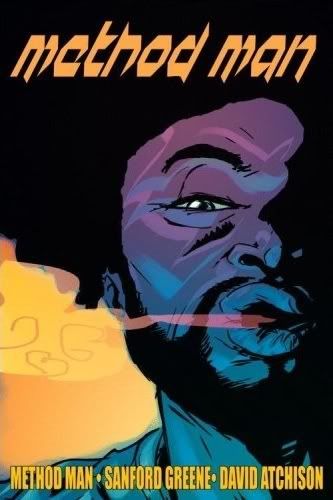
I recently had a chance to check out the Method Man graphic novel, courtesy of the nice people at Grand Central Publishing. It doesn't reinvent the wheel, but it's a lot of fun, a COMIC BOOK, in all caps.
Method Man stars as Peerless Poe, a "murder priest", excommunicated from his order of demon hunters. When the order faces a threat it can't handle alone, they call Poe in on it. That's when the fun begins.
Method Man incorporates enough Wu-Tang references to keep the fans that came for Wu-Tang happy. In addition, it has a nice back story, based on Biblical mythology. The artwork and story allude to further Wu-Tang comics.
As far as I know, the next Wu-Tang graphic novel will be GZA's Advance Knight. However, it was indicated to me that Advance Knight's publication has been postponed. Grand Central tells me that it is due to a rearrangement of the publishing schedule. I'll have more on that, as it develops.
Look out for my interview with Method Man co-writer David Atchison, coming soon.
Monday, June 30, 2008
RZA Album Cover artist, Gary Alford: Interview
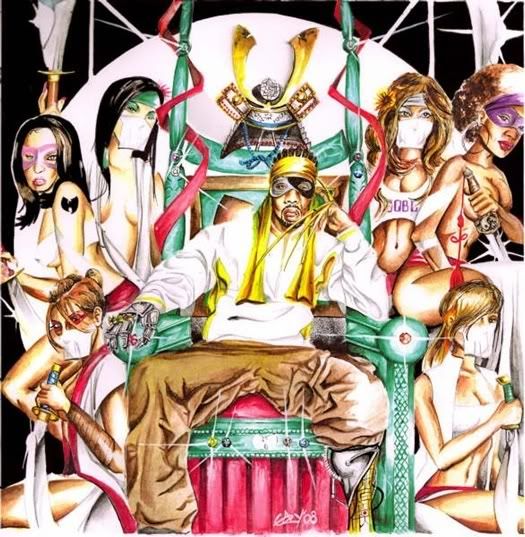
Gary Alford is a UK-based artist, well known for his portraits of the members of the Wu-Tang clan, which he sells at WuPoster.com, in conjunction with German Hip-Hop site Hip-Hop Dojo. Gary came to my attention through his album cover for the new RZA album, Digi-Snacks. I was extremely impressed with the rawness of his artwork and how well it defined the Bobby Digital mythos without any logos or words supporting it (the image is the whole of the album cover). Check it out above. I had a chance to catch up with Gary, recently. We discussed his work with RZA and the rest of the Wu family, his classical sensibilities, and some of his comic book interests. Enjoy.
Ian Thomas: I discovered your work through the cover to the new RZA album, but it seems like you've been at this for a while. Has the RZA cover been a big break for you?
Gary Alford:The RZA album cover has been a big break for me I guess as it is the RZA who I've been aiming to work with for a number of years and this album out of all my previous work will be the one that is most widely seen. I am happy with the way it has been received because I wasn't entirely happy with the cover myself initially. The picture that has been chosen was a relatively quick concept painting to show an intended layout. I spent a greater amount of time on a detailed oil painting which had a lot more depth and more of a story encapsulated within it. But RZA preferred the concept painting and seeing it manifested as the actual cover and that people are enjoying it means that I am happier with it.
IT: Did you set out to do album covers or was it a matter of the opportunity presenting itself?
GA: I had always wanted to album covers because I love artwork and love music and an album cover is the perfect marriage of these two things. I am into a wide range of music and appreciate just how much the album artwork can help or hinder the release. In my more fickle days, I would be completely put off an album or musician by the fact that the artwork was unattractive or became interested in someones music purely because of the artwork.
IT: On the WuPoster site, you mention all the hip hop related stuff that you have been doing lately. What is it about Hip-Hop that drew you in (no pun intended)?
GA: Hip-Hop got me at completely the right time in my life. It was 1994 just before it started becoming too commercial and you would be hard pushed to see an emcee on T.V unless it was on a late night trash program, where you might be lucky enough to catch a two minute feature on Ice-T or Snoop Dogg. I was right at that confusing, beginning-of-teens age and suddenly had no male role models around. Through Hip-Hop, I was able to hear the same kind of frustrations I had, which formed a bond between me and these people from what seemed a very far off place. It was the attraction of very different places and people than I was surrounded by seeming so familiar and kindred with myself that drew me to Hip-Hop. My way of honouring or expressing this was to draw these people. I spent most of my art lessons at school drawing emcees like Killah Priest, RZA and Xzibit and most of my time out of art lessons scrawling the Wu-Tang symbol on pretty much anything I could. When I was 18 I drew a samurai comic called The Twelve Jewelz which combined my love of Akira Kurasawa films and the Wu-Tang Clan.
IT: Stylistically, do you find that it's a challenge to distinguish yourself from all the other graphic artists in the hip hop game, given the recurring themes in Hip-Hop imagery/lyrics/etc.?
GA:It is a challenge to separate my artwork from other graphic artists who work in Hip-Hop, yes. This is because, as you rightly say, of the recurring themes and imagery but also because of what the fans want to see. Most of he time the fans would want to see an image of the emcee or
emcees and the emcees would like to be portrayed surrounding by the traditional themes carried through hip-hop i.e inner city or the images of power like the girls and the money. What I do is provide these themes but in a traditional method of painting or drawing rather than in the all too
common photo-shopped images. With the Digi Snacks album I tried to take the ideas I was given by RZA and put a different, more original twist on them, so I made it all look more gothic. The girls were still attractive, but looked like something from an H.R Giger painting; pale with tubes of twisted metal coming from their backs and breathing masks linked to Bobby Digital's biomechanical chair. None of the characters had pupils. Alas, RZA preferred the more traditional approach which in fairness fits this Bobby Digital character perfectly, he's all about the super hero b-boy surrounded by sexy women. If it was a RZA album then it would be a different scenario altogether, I doubt there would be any women on the cover.
IT: Have you had a lot of feedback from the Wu artists you depict for the posters?
GA: The work I did for wuposter.com focuses mainly on the core members of Wu-Tang and the first time I got to show them was in July 2007, after a London show. I was at the bar with Method Man as he flipped through a thick booklet of my Wu-Tang artwork and he really liked it. Method Man is a fan of artwork and has a huge comic book collection. These guys don't
throw around compliments lightly. Method Man called Raekwon over and showed him a drawing I had done of him in profile with his hand to his mouth with a ring on one of his fingers. As an artist you are not always happy with your work as you always see what you did wrong or could have done better but I like this drawing. Rae gave the drawing a quick glance and said 'I lost that ring.' And that was that ! Some you win. Generally, though it's a case of if they haven't said much about it it's a good thing, it's a sign of approval. It's the wider Wu family that I get the most feedback from, like 9th Princes pople, Kinetic, William Cooper, Prodigal Sunn, Timbo King, Dreddy Kruger, Bronze Nazareth etc. because we work closely together as they have exact ideas of what they want done, they'll be over the moon when you've got it right but won't hesitate to
ask you to re-do something if you have it wrong in the slightest way and I like that, that's a good working relationship that makes sure you have the best possible outcome between two minds.
IT: How/When did you hook up with RZA?
GA: My work with RZA has it's foundation in 2004 after a Wu-Tang show in London. I took a couple of small examples of artwork I did of the guys and handed them to Inspectah Deck's then manager, Banger, at the bull run between the stage and a rather hectic crowd. Banger got me backstage to meet the guys and RZA had my artwork on him which was incredible for me to
know. We spoke briefly, I was a little dumbstruck by meeting my idol and he said we would work together. After that, I worked closely with Banger and Deck on a short comic and a range of other artwork, which unfortunately didn't really materialize in any commercial way, except for some of it being used on Deck's website and on t-shirts which was good exposure. I then worked for a period of time on Masta Killa's 'Made In Brooklyn' album with Nature Sounds records, but my artwork was replaced at almost the last minute by the work of another artist that Masta Killa knew. Then, over the next few years, I worked with and discussed projects with other Wu family artists, one of them being Killarmy's Kinetic/Beretta 9, who is RZA's man at arms. That trail went dead and then I approached Hip-Hop Dojo in Germany about selling original Wu-Tang posters as they hadn't any on their online shop and Wuposter.com was born in summer 2007. I met RZA again briefly in July 2007, but all the books of artwork I took with me with which I had
intended to give RZA, had disappeared. I knew Meth had one and a slightly inebriated GZA had lost one, so my plans for that night had failed. In late 2007, I worked on the 'Prince Of New York' album for 9th Prince, who is RZA's younger brother. Then, out of the blue in February of 2008, I
received an email from Kinetic saying that RZA wanted me to start work on the forthcoming Bobby Digital album.
It was great working with RZA because this is what I had been aiming for, this was the guy that had inspired me for years with his work ethic and life story of pushing your creativity to try and find a way in to a better life. 'Persistence overcomes resistance' is one his sayings which I always
fall back on when things aren't going well. RZA had a very set mind [for] what he wanted from the cover and there was a hell of a lot of other work that went on for the album during the mid February to May period like the numerous album covers, comic, stage banners, tour bus wrap, character designs, etc. It was a very tight schedule for such a volume of work. During this time I spoke to RZA in LA a couple of times on the phone and met him and Kinetic in London in April where we made sure we both knew each others' minds on the artwork. It was a privilege to speak with RZA in a working and creative capacity.
IT: It's a pretty rare thing to let front album cover artwork stand on its own, without a logo or anything, but that's exactly how your work appears on the new RZA album.How much artistic direction did you get with the RZA cover? How much input did you have in its conception? Was it part of the plan from the beginning to have a censored and uncensored version?
GA: I was surprised and very happy to see that this is how the cover turned out. I can't think of another cover where it has just been artwork and no logo or name unless the CD is accompanied with a cardboard slip case displaying the band/artist information.
With the cover the basics were there in my mind and confirmed by RZA: Bobby on a throne surrounded by girls. I added all the other bits like the Twelve Jewels embedded in the throne, the gong silhouette as a background and Bobby's cybernetic hand and leg. I added weapons and assassin style veils to the girls as we were working under a different title for the album which was more war based. The decision to name the album Digi Snacks came from RZA quite late. I had drawn and painted a few different covers for RZA to choose from and this was his decision. I think he preferred the emerald throne as opposed to others that I had done with a metal or wooden appearance.
I was also surprised to see that the whole CD artwork package (i.e the back cover, inlay tray, full liner notes and even the CD itself) were my artwork. One of the very few and very definite guides that were mediated to me from RZA through Kinetic at the start of creating the album art was that there would be a censored and uncensored cover. The idea was that the cover with
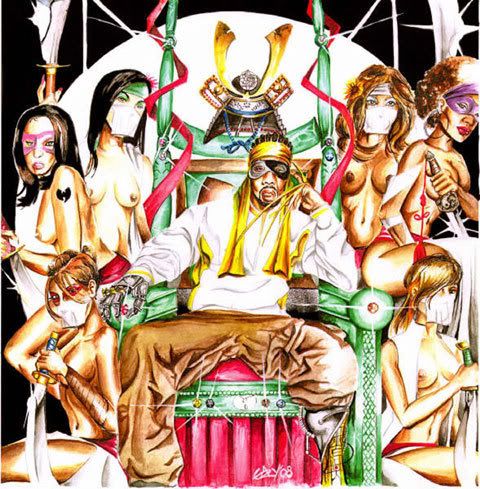
the topless assassins would be for the dirty language version of the album and the nipple-less version for a clean version.
IT: I was really digging the liner notes comic. Are there really plans to continue it, as the liner notes indicate?
GA: Thank you. With the comic, I had completely free reign. All that was discussed with RZA on the phone was that it should have Bobby fighting crime, with knowledge of the character I already had in mind. There is an intention to carry on the comic and story of Bobby Digital. RZA has created a whole concept of the story of Bobby, of which the fans only know a very small amount, so far. There is a history of the character that has yet to be told, which RZA touches on with the story being read by the child on the intro to the album. There are a number of characters from Bobby's world to be explored, one of which, The Raven, I made sure to introduce in the liner comic. The ideas RZA has for Bobby means that this character is going to run and run, not only in albums but comics and film.
IT: You seem to feel equally comfortable laying out comic book pages and doing more design heavy poster art. Which of these is more fun for you? Which do you tend to pursue more, professionally?
GA: I enjoy both and I like having the option of both. I may have my teeth into a comic book storyline and then want a break to do more free standing, singular pieces of artwork and then straight back into the comic. I like the work ethic and regimen involved in a comic in which you
are following a narrative. And then I [also] like creating a one off painting, in which maybe a narrative isn't so clear and is done for the love of painting. If people want to create a story of their own from a painting, then so be it. It doesn't matter if it wasn't my intended story. The
beauty of art is that someone can take their own personal angle and make it theirs. In this vein, I would say that my intention is pursue more of a painting on canvas career.
IT: Who are your artistic influences?
GA: My artistic influences come from more traditional artists like Caravaggio and the beautifully realistic paintings of Norman Rockwell. I also like the almost impressionistic paintings of Amadeo Modigliani, who did very simple portraits of mainly women, but within their simple lines and flat colour there was a definite description of the grim life of the artist plagued with illness and poverty. I really admire the technical and architectural paintings of Canaletto and am inspired and in awe of the incredible attention to detail and perspective evident in the work of architect and etcher Piranesi. I also really like the morbid 16th century landcapes and town life observations of Flemish artist Pieter Bruegel.
IT: Are you into comics? If so, which ones?
GA: I can't claim to be any kind of authority on comics, I have a number of comics but they are rarely of full series. I generally buy the odd one here or there if my attention is caught by the cover. I had comics when I was a kid and was fascinated by Spider-man and Batman. I liked the sense of determination through struggle and bereavement that a lot of the comics had, like the way Batman and Spider-man carried a terrible pain around with them and turned it's potentially destructive nature into good. It wasn't until my early twenties, when I bought a cheap stack of Spawn graphic novels from a stall, that I really got into a comic book story. The period of Spawn I bought was when Greg Capullo was illustrating and I liked his style because he used heavy hatching lines to great effect, which I was always spurned for using at art college. The Spawn story lost impact for me after a while when some of the more interesting aspects were lost and
the stories rolled around a bit repetitively.
I have a stack of 2000 A.D comics dating from around 1993 to '95 that were given to me. From this pile I discovered the work of Dermot Power who Illustrated a beautiful Judge Dredd story based in Egypt called Book of the Dead amongst many other things. Each frame could hold it's weight as a painting on it's own, the attention to detail and understanding of shade and shadow in what is a tight deadline industry is inspirational. I like 2000 A.D for the very reason that the artwork was very different from what could be quite ugly, simple line and colour work of Marvel and D.C comics. While most comics had great covers, the inside artwork couldn't match up,
but, with work like Dermot's, the artwork was just as incredible throughout, as on the cover.
IT: What's next for you? If you had unlimited
resources what kind of projects would you pursue?
GA: After RZA has done his thing as Bobby, promoting Digi Snacks, we will hopefully work together on future Bobby Digital projects like the comic, a film, and a computer game.
IT: What are your upcoming projects?
GA: I have some more album artwork projects lined up, one being American Poets 2099, which includes Holocaust/Warcloud of the Black Knights, as well as the next Black Knights album cover. I am working on projects with Aslan the Black Magician, who's part of the Wu-Tang Maccabee family and runs Twelve Jewelz productions. One of these projects is an album by Aslan and Killah Priest. I have commissions here and there including one for Killa Sin.
IT: If you had unlimited resources what kind of projects would you pursue?
GA: Mainly, I want to put more focus into my own projects and paintings to build more of a reputation as an artsist here in London. I would like to get a relationship with a gallery up and running where I can spend time doing paintings to sell. I did a book a couple of years back called The Book Of Dead Children , which I would really like to get published. [It would be] expensive to do, so unlimited funds would definitely make that happen, as well as giving me the foundation to be able to do my artwork full time. My goal is to be able to spend my days creating my artwork. I don't have to make a fortune out of it, just be able to build a life that I can be happy to look back on one day and be satisfied that I spent it creating.